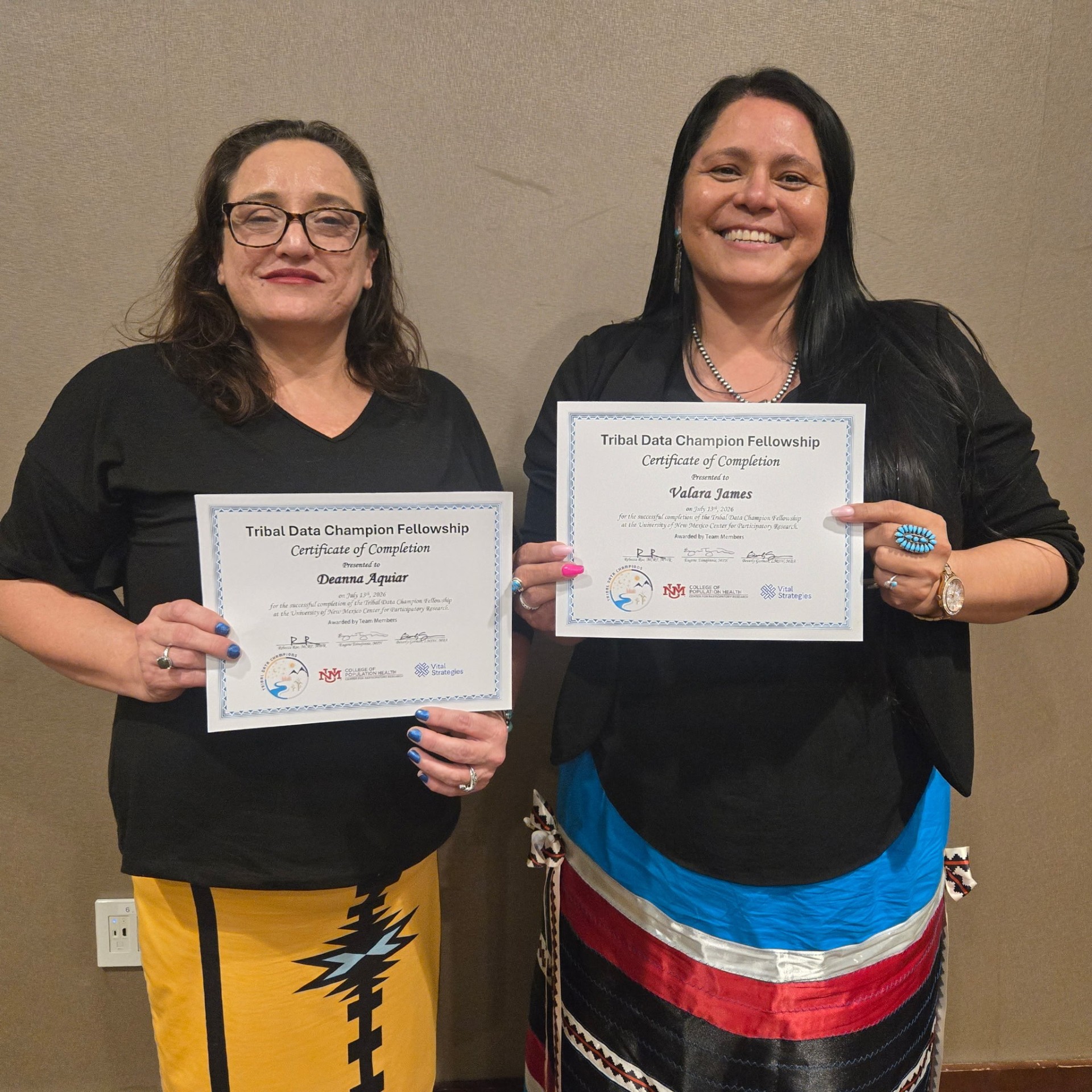
Fellowship strengthens organizational capacity to use data in support of Native workforce development, community advocacy, and self-determination.
ALBUQUERQUE, NM — The Native Professional Advancement Center (NPAC), powered by the National Indian Youth Council (NIYC), is proud to announce that Deanna Aquiar, Director of Programs and Development, and Valara James have officially completed the Tribal Data Champion Fellowship as of Monday, July 13, 2026.
Their completion of the fellowship marks an important milestone for NPAC/NIYC as the organization continues to strengthen its ability to use data, storytelling, and community-rooted evaluation to support Native workforce development, education, advocacy, and long-term program sustainability.
The Tribal Data Champion Fellowship is designed to build the capacity of Native leaders and organizations to better understand, manage, interpret, and apply data in ways that reflect Indigenous values, community priorities, and tribal sovereignty. For NPAC/NIYC, this work is especially timely as Native-led workforce programs continue to navigate a shifting federal and state funding landscape.
“Completing this fellowship has strengthened the way I think about data—not just as numbers, but as a tool for protecting our stories, proving our impact, and advocating for our communities,” said Deanna Aquiar, NPAC’s Director of Programs and Development, member of the Ysleta del Sur Pueblo. “For Native organizations, data must always be connected to people, place, culture, and self-determination. This experience helped us sharpen how we measure success while staying grounded in the communities we serve.”
Through their fellowship project, Aquiar and James focused on strengthening NPAC/NIYC’s ability to better collect, organize, and use workforce program data to tell a more complete story of participant success and community impact. Their work supports NPAC’s long-term goal of demonstrating how Native-led workforce development programs help participants gain skills, access employment, overcome barriers, and contribute to stronger local economies.
“This fellowship gave us tools to better connect data with action,” said Valara James, NPAC’s Job Developer, member of the Navajo & Modoc nations. “When we can clearly track participant outcomes, identify barriers, and communicate our impact, we are better prepared to improve services, support our staff, and advocate for the resources our communities deserve. This is about building stronger systems from within.”
The achievement also comes as NIYC celebrates more than 65 years of service to Native communities. Founded in 1961, NIYC has long been a leader in Native civil rights, workforce development, and self-determination. Today, through NPAC, the organization continues that legacy by providing culturally grounded programs that support Native individuals across Albuquerque, Gallup, Farmington, and surrounding communities.
“This accomplishment is a major step forward for NPAC and NIYC,” said Darius Lee Smith, Executive Director of NPAC/NIYC. “Deanna and Valara’s work strengthens our internal capacity, our accountability, and our ability to advocate for Native workforce development with clarity and confidence. As we continue to make the case for sustained investment in Native-led programs, having strong data leadership inside our organization is essential.”
Smith added that the fellowship supports NPAC/NIYC’s broader vision of ensuring Native communities are not only represented in workforce conversations, but also equipped to lead them.
“Our communities have always had knowledge, expertise, and solutions,” Smith said. “The challenge is making sure systems recognize and respect that. This fellowship helps us build the tools to document our impact, strengthen our programs, and make sure Native people remain at the center of decisions that affect our future.”
NPAC/NIYC congratulates Deanna Aquiar and Valara James on this important achievement and looks forward to applying their fellowship learning to strengthen data-informed program development, participant support, community partnerships, and advocacy efforts across New Mexico.